
LGIP, LGMS and the City Plan: What’s the difference and why it matters
Part 1 of my planning series
By 2046, the Gold Coast is expected to have:
- 388,300 more people (total of 1 million)
- 173,800 new jobs
- 185,300 new homes
Over the past few weeks, I’ve been reading two major planning documents:
- The Interim Local Government Infrastructure Plan (LGIP)
- The Local Growth Management Strategy (LGMS)
They are related, but they are not the same thing.
This is the first part of a blog series, looking first at the LGIP, then the LGMS. The series will be updated as new information becomes available.
Before getting into concerns, it’s important to explain the difference.
First: What is the City Plan?
The City Plan is the rulebook.
It sets:
- Zoning
- Building heights
- Density
- Assessment rules
- Overlays (flood, heritage, environment etc.)
If you lodge a development application to Gold Coast Council, it’s assessed against the City Plan.
The City Plan is statutory, that is, it has legal force.
What is the LGIP?
The Local Government Infrastructure Plan (LGIP) sits inside the City Plan.
It sets out when and where the City will deliver trunk infrastructure such as:
- transport (roads and intersections)
- stormwater
- water supply and sewerage
- public parks and sports grounds
- land for libraries and community centres.
The LGIP includes existing and projected populations and dwellings by suburb, to help plan infrastructure.
An interim LGIP, which updates pricing, timelines and projected population numbers is currently open for public submissions.
More on that below.
What is the LGMS?
The Local Growth Management Strategy (LGMS) is new.
It is not statutory, but it sets the direction for the next City Plan, which we’re expecting to see in 2027.
It answers the question:
Where could growth go in the next 20 years?
The three together
Think of it as:
LGMS = strategy
LGIP = infrastructure modelling
City Plan = legal framework
They talk to each other.
“Have Your Say” Concerns
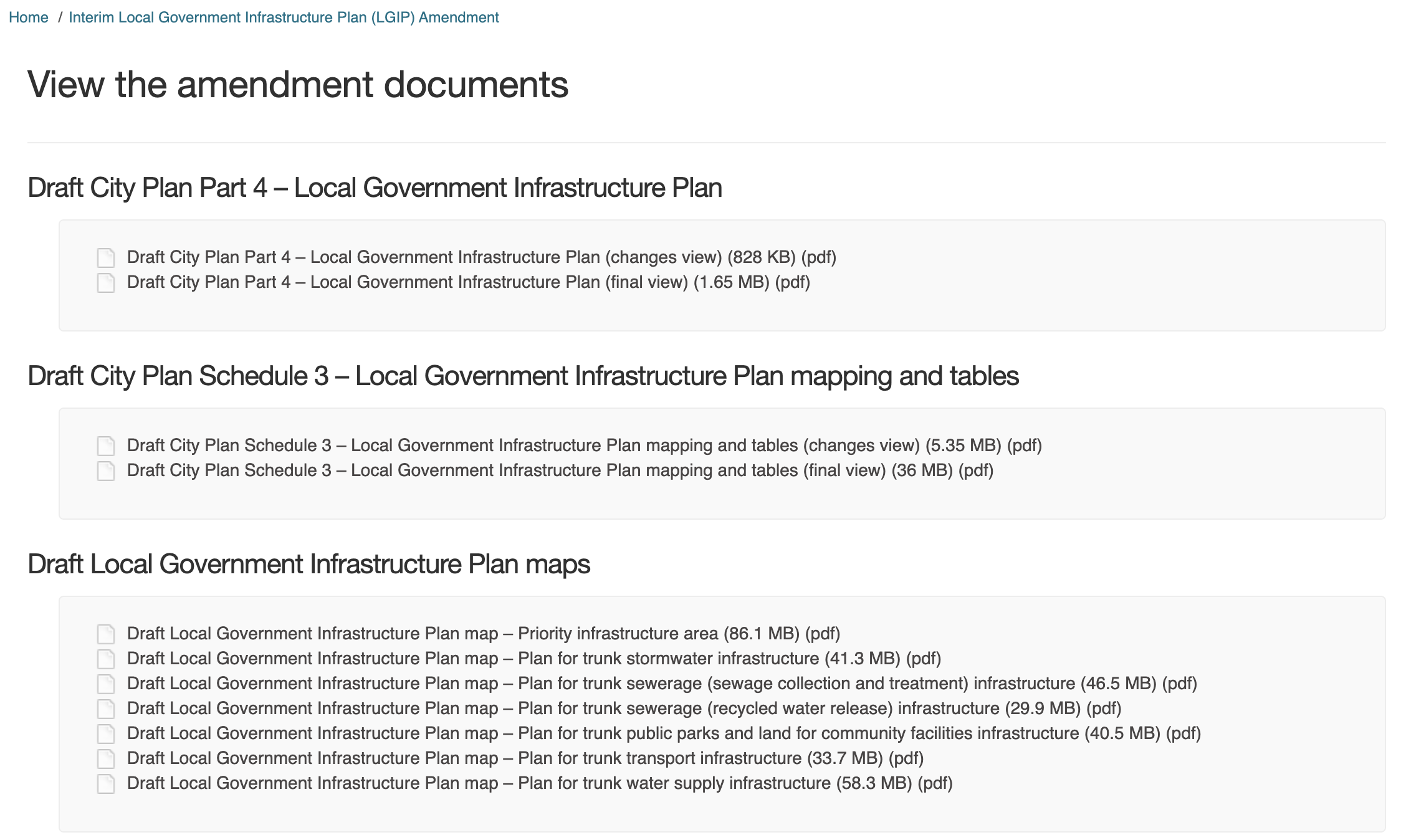
I posted this video recently, when the Interim Local Government Infrastructure Plan (LGIP) Amendment went live on the council’s website.
It’s worth noting that I quoted some incorrect numbers regarding “dwellings” as I was getting the many tables in the documents confused. Looking at the document again, it’s not hard to do, the general concerns raised remain relevant.
1. Suburb projected growth is highly uneven
When you compare projected population and dwelling increases across Gold Coast suburbs (2026–2046), the differences are significant.
In order of highest projected population growth:
- Southport (North + South combined)
- +40,000 people
- +15,500 dwellings
- Southport is the Principal Regional Activity Centre, CBD and has multiple light rail stations.
- Mermaid Beach – Broadbeach
- +33,000 people
- +11,000 dwellings
- An established high-rise coastal corridor.
- Labrador
- +18,500 people
- +8,200 dwellings
- This places Labrador third city-wide for projected growth
- Biggera Waters
- +11,000 people
- +3,600 dwellings
- Nerang – Mount Nathan
- +8,000 people
- +3,500 dwellings
- Palm Beach
- +7,300 people
- +3,300 dwellings
Some other areas likely of interest to compare to our area:
- Broadbeach Waters:
- +280 people
- Less than +300 dwellings
- Miami:
- +1800 people
- +330 dwellings
- Paradise Point:
- +2,800 people
- +1,100 dwellings
For the other Division 7 suburbs, they are projecting:
- Arundel:
- -381 more people
- 139 more dwellings
- Molendinar:
- 596 more people
- 19 more dwellings
- Parkwood
- -117 people
- -1 more dwellings
Compare these numbers to the mapping of where growth “could” go in the LGMS, and we see those huge increases in Labrador reflected. But that’s another blog post…
For now, the key point is this: if these projected increases are to occur, infrastructure must be planned, funded and delivered to support them. Growth of this means pressure on roads, transport, community facilities and schools.
2. Communication
These are complex documents with long-term implications, yet there has been no clear suburb, divisional or city-level explanation of what they actually mean.
Instead, we have been left to navigate technical documents and work out what we are being asked to “have our say” on.
If the community is invited to comment on city-shaping decisions, then a copied survey link on social media isn’t enough.
We deserve plain-language explanations of what this means for our area.
That is the role of local representation — and it is currently missing.
3. Parks and community infrastructure
The LGIP includes scheduled upgrades in Division 7 such as:
- Labrador Community Centre extension acquisition (2026 Labrador Squash Club) – $3.5m
- Labrador Community Centre extension works (2031) – $1.2m
- Len Fox Park Major Upgrade (2031) – $3.2m
- Marine Parade Foreshore Reclamation Stage 1 (2031) – $6.8m
- Parkwood–Arundel Community Centre (2041) – $400k
- Harley Park Major Upgrade (2041) – $3m
- Cos Zantiosis Park Major Upgrade (2041) – $2m
- Keith Hunt Park (2041) – $3m
Neighbouring areas include:
- Paradise Point Parklands Major Upgrade (2026) – $1.5m
- Southport Broadwater Parklands Phase 1 (2031) – $8.1m
- Southport Broadwater Parklands Phase 2 (2036) – $2.7m
It’s important to acknowledge that Division 7 is not being ignored in infrastructure planning, with substantial park upgrades and community facility improvements mentioned over the next 20 years.
4. Timing of infrastructure + the Olympics and future growth
It’s worth looking at the timing of these projects.
Firstly, it’s interesting to see suburbs like Paradise Point having upgrades in 2026, given their modest growth projections and already well-developed park facilities.
Secondly, the 2032 Olympic and Paralympic Games are coming to the Gold Coast. Labrador will excitedly host the hockey, putting our suburb on a global stage.
Looking at Labrador’s major park and foreshore projects, they’re not scheduled until 2031 and 2041.
If we’re expecting significant population growth and international sport in 2032, it’s reasonable to ask whether some of these upgrades should be brought forward.
If growth and major events are coming, let’s plan infrastructure early so we’re ready, rather than playing catch-up.
Lastly, the same applies to Marine Parade, Labrador Foreshore or “Broadwaterway”. This isn’t the first time we’ve seen foreshore reclamation being listed in long-term infrastructure planning. Firstly, clarity is needed on whether that decision has been made.
Alternative options, such as making the street one way and using road space, or creating a boardwalk, have previously been discussed. No decision has ever been shared with the community.
To sum it up
The projected growth numbers in the Interim LGIP are significant — particularly in Labrador.
Southport and Broadbeach are already high-rise centres with established transport infrastructure. After those two, Labrador — which does not have multiple light rail stations or a major employment centre — is projected to have the third-largest increase in population and dwellings across the city. Meanwhile, several surrounding suburbs are shown as flat or declining.
If growth is being targeted in certain areas, the community should be told clearly why.
Unfortunately, that explanation has not been provided.
There are also broader timing questions.
The LGIP was updated only a couple of years ago. A new City Plan is expected next year, which will bring with it a full (non-interim) LGIP. This interim amendment updates costs — which is understandable — but it also revises population and dwelling projections in some areas. It’s reasonable to ask why those projections are being adjusted now, ahead of the new City Plan, and what assumptions are driving those changes.
Why now?
How does this align with the forthcoming City Plan and LGMS?
If this Interim LGIP is influencing where growth is directed and where infrastructure investment follows, then context and transparency should not be optional.
Community consultation should go beyond linking to documents and sending us on our way to “have your say”. It should require clear explanations of the intent behind them and how they talk to other documents. In lieu of that, our local representation should be providing the localised context we need.
Growth is coming. Housing is needed. We need to get this right.
I’d love to hear your thoughts in the comments.
In the next post, I’ll look at the LGMS mapping and how it aligns with the LGIP.
Newsletter signup
Stay up to date on local issues:
Other blog posts in this series
- Understanding the Gold Coast’s Local Growth Management Strategy (LGMS)
- Local Area Plans Are Back… Who Gets One, And Who Doesn’t?