
Gold Coast aquatic centres outsourcing: what will actually change?
Every Saturday, my family is at the Gold Coast Aquatic Centre. We’ve been regulars there for around eight years. One of my daughters started out in Learn to Swim and now takes part in a competitive sport at the centre, while my youngest is currently doing Learn to Swim lessons.
So when news broke that Council was considering outsourcing the management of its aquatic centres and what that could mean for the staff we’ve come to know over the years, I became really concerned.
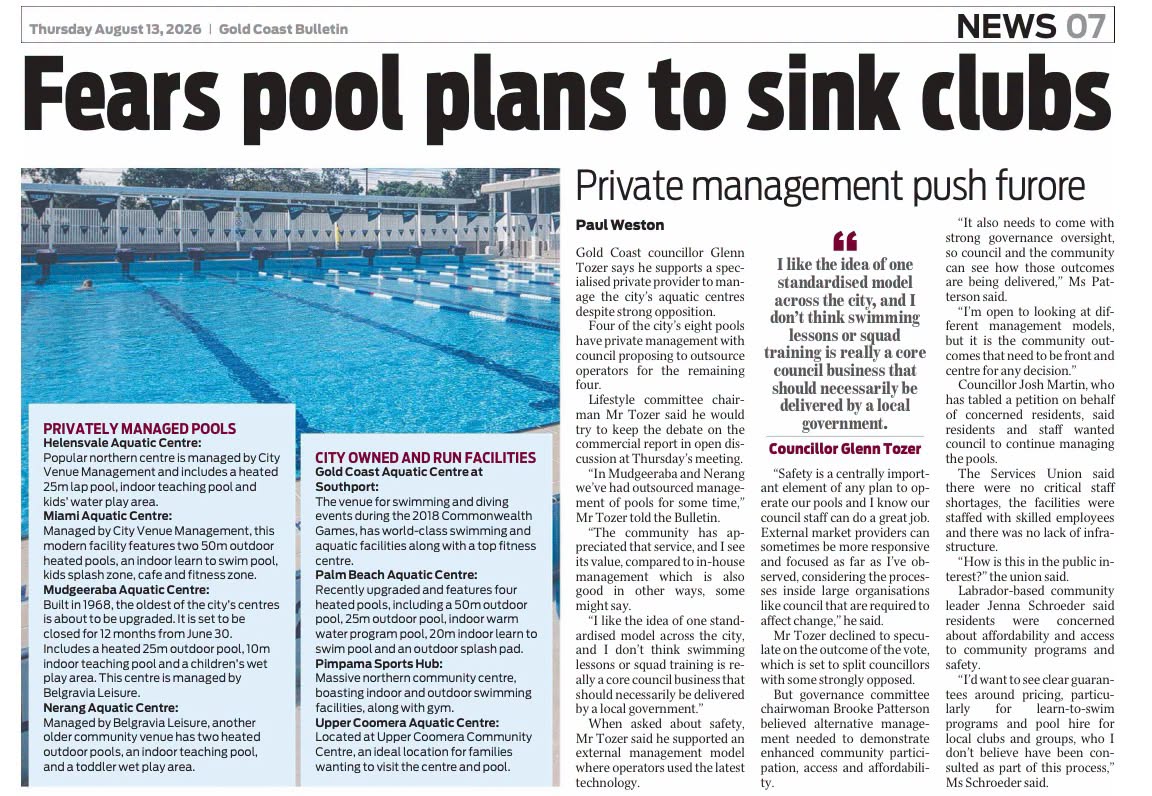
In August 2026, Gold Coast City councillors voted to change the way its eight aquatic centres are managed, moving to a single private operator across the network.
Four centres are already privately managed. The decision means the four currently operated directly by the City will also move to private management, and all will have the one provider.
The four pools currently managed by the city are:
- Gold Coast Aquatic Centre at Southport
- Palm Beach Aquatic Centre
- Pimpama Sports Hub Aquatic Centre
- Upper Coomera Aquatic Centre
The facilities themselves are not being sold. They will remain publicly owned, and Council will retain oversight of areas including fees, governance, compliance and community and safety outcomes.
Council has now made that decision. What I’m interested in is what it will actually mean for the people who use these facilities and the people who currently work in them.
Why did Council decide to outsource the Gold Coast aquatic centres?
The argument for the change is that a single operator can provide a more consistent service across the city while delivering an estimated $22 million net benefit over ten years.
The proposal was controversial from the beginning, with concerns raised about staffing, pay and conditions, fees, safety, community consultation and whether outsourcing was actually necessary to achieve the promised improvements.
The proposal initially failed 5–1 at the Lifestyle and Community Committee, at Full Council, however, it passed 9-6.
Since then, Division 7’s Cr Wilkinson has published a lengthy explanation of his decision, promoting benefits including:
- greater consistency between centres
- improved access through a network membership model
- “expanded Learn to Swim pathways”
- “enhanced programming opportunities”
- stronger partnerships with schools and community groups
- “improved fitness and wellbeing offerings”.
Those phrases sound impressive. But what do they actually mean for people using the pools?
Why did six councillors vote against the aquatic centre outsourcing?
The final vote was 9–6, with six councillors voting against moving all eight aquatic centres to a single private operator.
Several councillors questioned whether Council needed to go as far as handing the entire eight-centre network to one operator, particularly when the City-run centres were already performing well.
Cr Naomi Fowler spoke strongly about the impact on staff and the value of the knowledge that already exists within Council’s aquatic workforce.
The line that stayed with me was:
“You do not replace decades of local knowledge with a contract.”
She questioned why Council would make such a significant change when the centres were already performing well, and whether the financial savings justified what could be lost in staff experience, relationships and institutional knowledge.
Cr Gail O’Neill wasn’t convinced the proposal demonstrated that residents would actually receive a better service. She said she was “on the side of services rather than savings”.
Cr Nick Marshall, Cr Josh Martin and Cr Dan Doran all raised variations of a more cautious alternative: why not retain major flagship facilities such as Southport and Palm Beach under City management rather than outsourcing everything at once?
Cr Brooke Patterson raised another long-term concern: what happens when Council gives up its internal capability? Once Council no longer directly operates an aquatic centre, it loses the workforce, systems and practical knowledge required to do so. She also questioned what consolidating all eight facilities under one operator could mean for competition and Council’s options in the future.
Cr Dan Doran also challenged the idea that rejecting this particular $22 million projected benefit meant councillors weren’t taking their responsibility to ratepayers seriously. His argument was that Council makes choices about where to pursue savings all the time, and financial return isn’t the only measure of the value of a public service.
There was a middle ground available between “Council must operate everything” and “one private operator should manage all eight centres”.
What are the “expanded Learn to Swim pathways”?
Back to the benefits… Some wording Cr Wilkinson used, “expanded Learn to Swim pathways” sounds like a substantial expansion.
When I asked what it actually meant, one of the examples given was Sunday Learn to Swim classes…
Except three of the four Council-run aquatic centres already offer Learn to Swim on Sundays. The only one that doesn’t currently offer any lessons at all is unable to because of an existing contractual arrangement.
So what exactly is the new “pathway”?
This is where some of the language starts to feel like word salad.
And it makes me want the same clarity around the other promises, since these are being presented as reasons outsourcing will deliver a superior service.
If they’re part of the case for changing how our public pools are managed, residents should be able to understand exactly what we’re getting.
What does a network membership actually offer?
Another benefit promoted by Cr Wilkinson is “improved access through a network membership model”.
When I asked what evidence supported the likely uptake of this, he pointed to increased participation through Fitness Passport at the four facilities where it is currently available.
As a Fitness Passport member, I’m not convinced increased Fitness Passport use demonstrates demand for an eight-centre council membership. I pay $33.20 a fortnight, and it gives me access to a huge network of participating gyms and aquatic centres. It was cheaper than any individual gym membership I could find locally. By comparison, a Gold Coast Aquatic Centre membership alone is around $50 a fortnight.
Increased Fitness Passport attendance may simply show the appeal of a cheaper membership with a much larger network, rather than demand for access to eight Council facilities. That’s why I’d be interested in seeing the actual usage data.
Do people regularly travel between Council aquatic centres? Or do most people predominantly use facilities close to home?
Personally, I use Gold Coast Aquatic Centre and Runaway Bay Performance Centre because they’re my nearest facilities and offer different classes. I’d have little reason to travel across the city to use another Council pool.
If the network membership is being presented as one of the significant benefits of outsourcing, I’d like to see the evidence that demonstrates the demand for it. The price will also determine whether it’s actually good value and if it will have uptake.
Could Council have made these improvements itself?
This question has been raised repeatedly.
Could Council create a broader membership?
Could it standardise programs?
Could it expand classes?
Could it strengthen school partnerships?
Could it improve fitness offerings?
And, importantly, what attempts were made to implement those changes before deciding the operating model itself needed to change?
Questions from councillors during the debate also suggested these improvements had not previously been attempted under the existing City-run model.
Will Gold Coast aquatic centre fees increase?
This was one of the biggest concerns before the vote.
I told the Gold Coast Bulletin at the time:
“I’d want to see clear guarantees around pricing, particularly for learn-to-swim programs and pool hire for local clubs and groups, who I don’t believe have been consulted as part of this process.”
I also raised the importance of access for sporting organisations:
“Some of the groups using our pools are developing our future Olympic and Paralympic athletes, and we shouldn’t make it harder or more expensive for them to access the facilities they need.”
Council will retain control over fees and charges, and annual reviews of programs and fees will come back through the Lifestyle and Community Committee.
That’s an important safeguard, but as the transition happens, I’ll still be watching the actual prices paid by families, clubs, schools and community groups.
Because maintaining an entry price doesn’t necessarily tell us what happens to memberships, programs, lessons, lane hire or other costs associated with using these facilities.
What happens to Gold Coast aquatic centre staff?
This is the part that has bothered me the most. Council is one of the Gold Coast’s largest employers. I believe it has a responsibility to lead by example in how it treats its workforce.
Cr Wilkinson’s post says the proposed operator is expected to offer approximately 460 employment opportunities, compared with the City’s current aquatics workforce of 297 employees. On first reading, that sounds like the new model will create more than 160 additional jobs.
But that comparison needs some fairly significant context.
During the Full Council debate, Cr Glenn Tozer explained that the higher workforce figure relates to peak summer operations, and that 460 figure is close to what the City already reaches now.
That means the figures aren’t comparing like with like: one is a peak workforce figure, while the other is current winter staffing.
Staff who transfer will move from Council’s agreement to the fitness industry award, resulting in lower rates of pay and conditions.
I was at Gold Coast Aquatic Centre again today, and staff told me the operator is likely to take over around November, although Council has not publicly confirmed the successful operator at the time I’m writing this.
What was particularly difficult to hear was that casual employees I spoke with still don’t know what is happening to them.
We’re now potentially only a couple of months from transition and some of the people actually working in these facilities still don’t know what their employment will look like.
Standing there talking to them today, I felt awful for them.
Whatever position you take on outsourcing, people deserve clarity about their livelihoods.
Where does the $22 million saving come from?
Council has forecast the new model will deliver an estimated $22 million net benefit over ten years.
From the information presented, those savings are expected to come from three main areas:
- reduced staffing costs
- increased revenue
- reduced operating costs
And as Cr Peter Young suggested during the debate, if those projected savings are achieved, I’d like to see some of that benefit returned to the people using the facilities through lower pool fees and passes.
Were residents consulted about outsourcing the pools?
Consultation was another concern raised before the vote.
These facilities are used by families, swimming clubs, schools, athletes, community organisations and thousands of individual residents.
Cr Wilkinson has said that he engaged with residents before making his decision, so I asked what this involved and if he had gone to the aquatic centres and spoken with staff and the people who use them.
His response was that his “door is always open” and residents are welcome to contact him.
But that’s not the same thing as consultation.
An open-door policy relies on residents already knowing a major change is being considered, understanding its potential implications and then taking it upon themselves to contact their councillor.
Proactive consultation means taking the initiative to seek out the people affected, explaining what’s being considered and asking for their views before the decision is made.
For a change of this scale, I would have liked pool users, staff, clubs and other community groups to have had a meaningful opportunity to contribute.
So what happens now?
I’m not opposed to private operators simply because they’re private operators. Four of the City’s aquatic centres were already privately managed before this decision, and I genuinely hope the new model succeeds.
I use these facilities. I want them to be affordable, safe, well-run and sustainable.
A genuinely affordable membership across all eight centres could be useful. There may be efficiencies from managing the facilities as a single network. There may be new programs that residents end up loving.
But from here, I think we need to judge the decision against what was actually promised.
Does the $22 million net benefit materialise?
Do memberships remain affordable?
What happens to Learn to Swim prices?
What happens to pool hire for clubs and community organisations?
Do we actually get substantially different programs and services?
What happens to experienced staff?
Will the staff remain consistent and caring, particularly Learn to Swim teachers?
And when we’re told we’re getting “expanded Learn to Swim pathways”, “enhanced programming opportunities” and “improved fitness and wellbeing offerings”, can someone please tell us what those things actually mean?
Because if “expanded Learn to Swim pathways” means Sunday lessons that already operate at three of the four affected centres, that’s not much of an explanation.
It’s word salad.
Newsletter signup
Stay up to date on local issues: