
Local Area Plans Are Back… Who Gets One, And Who Doesn’t?
Part 3 of my planning series
This is the third part of a blog series, looking first at the LGIP, then the LGMS. The series will be updated as new information becomes available.
—
Local Area Plans are coming back to the Gold Coast’s City Plan.
They’re supposed to help shape how our suburbs grow — including protecting local character where change is coming.
So why aren’t Labrador and Parkwood included?
What are Local Area Plans?
Council describes Local Area / Neighbourhood Planning as:
a way for “communities to help shape the future of their local areas. Rather than applying a single planning approach across the city, a localised approach enables responses that reflect local character, address area-specific challenges, and guide change at a finer scale.”
They were removed back in 2016, so their return is a big shift.
How we got here
Back in October 2025, at a Planning Committee meeting, councillors discussed how Local Area Plans would be brought back.
They were told:
- there would be clear criteria for assessing and deciding where they apply
- communities could be better reflected in planning
- councillors could raise areas they wanted to advocate for
In discussion, Cr Hammel even said that if councillors would like to publicly signal their focus on a particular area, and that they are listening to the community, they could look for opportunities to do so in the future.
That’s worth remembering.
In November 2025, full Council formally endorsed moving ahead with this approach.
Then in March 2026, we saw more detail, with councillors considering officer recommendations on which areas should receive Local Area Planning.
You can see the report and recommendations in the agenda from this meeting here.
How areas were assessed
Step 1: Reviewing 39 ‘places of interest’
Labrador and Chirn Park were included in the list of 39 areas that were assessed.
An area could be considered for Local Area / Neighbourhood Planning if it met at least three of the following criteria:
- be an area having a unique city character or special characteristics
- be part of an area identified for city renewal, city growth or requiring specific local urban design outcomes
- be designated for catalytic infrastructure investment
- have a clearly defined specialised role or function; and
- be subject to specialised governance arrangements, master plans or other legislation.
Step 2: Shortlisting to 19 areas
- 19 areas were shortlisted from the 39 and assessed against:
- Proposed Planning Scheme Architecture
- The Local Growth Management Strategy (LGMS)
- Neighbourhood Framework
- Place making and master planning activities; and
- Catalytic Infrastructure projects.
At this stage, Labrador and Chirn Park were not assessed further, though the report does not outline why.
Step 3: Categorise the areas
Council looked at the 19 shortlisted areas to decide the best way to manage them, while keeping the new City Plan workable.
They then split them into groups:
- some areas will get a Local Plan in the new City Plan
- some will be handled through normal planning tools like zoning or overlay
- others will be considered as future amendments to the new City Plan — these are the ones I’m most interested in.
What made the cut?
4 will get Local Plans in the new City Plan:
- Gold Coast Cultural Precinct (HOTA)
- The Spit
- Robina
- Mudgeeraba Village
7 will be built into the new City Plan through zoning, built form provisions and/or overlays:
- Broadbeach
- Burleigh Heads
- Coolangatta
- Kirra
- Nobby Beach
- Palm Beach
- Surfers Paradise
8 areas around light rail stations through zoning, built form provisions and/or overlays:
- Nobby Beach
- Miami North
- Christine Avenue
- Second Avenue
- Mermaid Beach
- Mermaid Beach South
- Miami
- Burleigh Heads.
This will be “in consideration of the planned character”.
6 other areas will have local area / neighbourhood planning undertaken for future City Plan amendments:
- Helensvale and Environs
- Nerang and Environs
- Coolangatta and Environs
- Mudgeeraba and Environs
- Elanora
- Worongary
These are the areas Council has effectively said they need more detailed, local planning, and in some cases, to protect local character.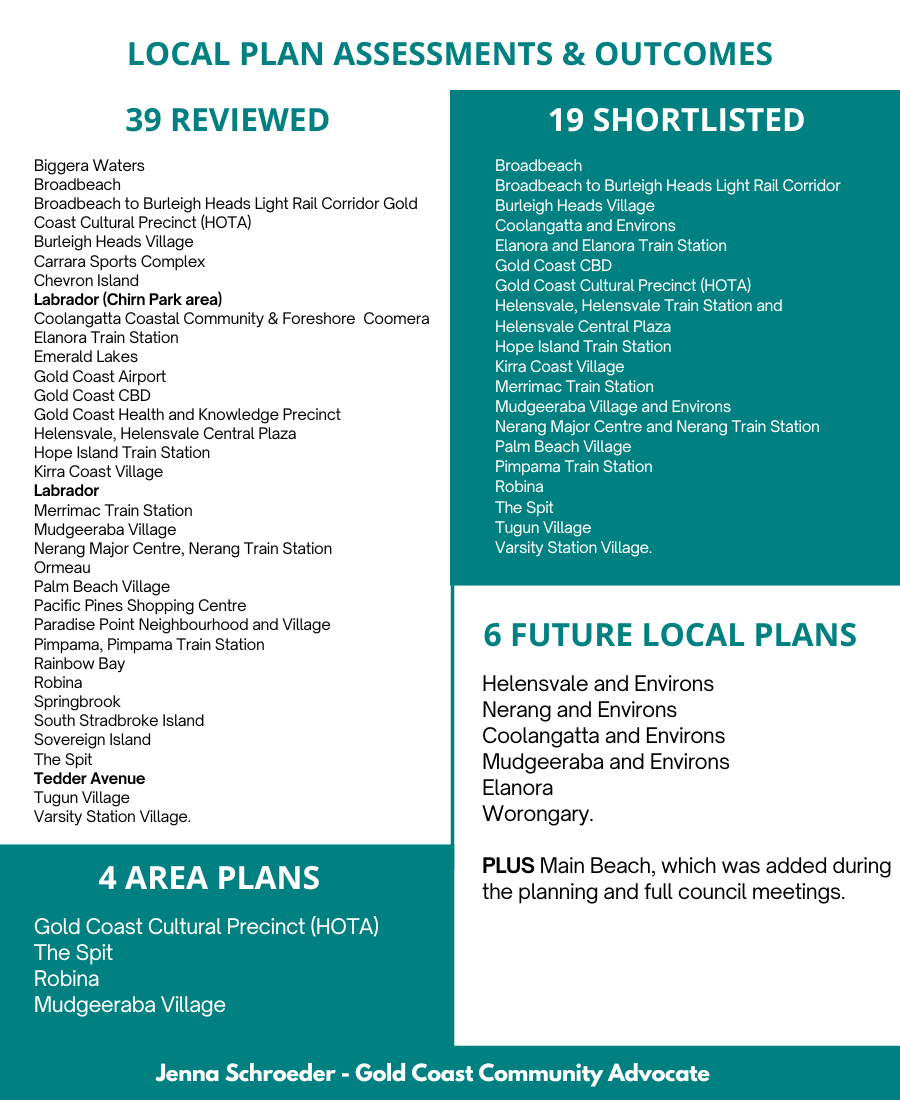
Which makes what happened next hard to understand…
At the March Planning Committee meeting, something else happened.
Cr Brooke Patterson asked to have Benowa added to the list, but was told it doesn’t meet the criteria.
Cr Darren Taylor — who isn’t on the Planning Committee — attended and successfully had Main Beach added.
However, Main Beach was not part of the 39 areas assessed (only Tedder Avenue was referenced). It was also not part of the 19 shortlisted areas.
And yet, it was still added at the committee stage and endorsed at full council.
Which raises an obvious question:
Why wasn’t there a similar push for our area?
From a community standpoint, based on Council’s own criteria, Labrador, Chirn Park and Parkwood should warrant consideration.
Labrador / Chirn Park:
- Identified in the LGMS for increased growth, with light rail proximity referenced as a justification
- Projected to have one of the highest population increases in the Local Government Infrastructure Plan (LGIP)
- Past attempts have been made to increase height and density with City Plan amendments
- Long-standing community concern around the loss of special character
Parkwood:
- While Helensvale and Elanora were chosen due to growth opportunities overlapping with koala habitat, the significant koala habitat of Parkwood/Arundel/Coombabah has been ignored
- Worongary and Mudgeeraba were included to ensure the areas can retain their unique rural character. This is something many Parkwood residents feel strongly about.
The process itself is clearly set out — but the decisions made don’t appear to follow it consistently.
An ongoing issue with consistency
This isn’t the first time we’ve seen this.
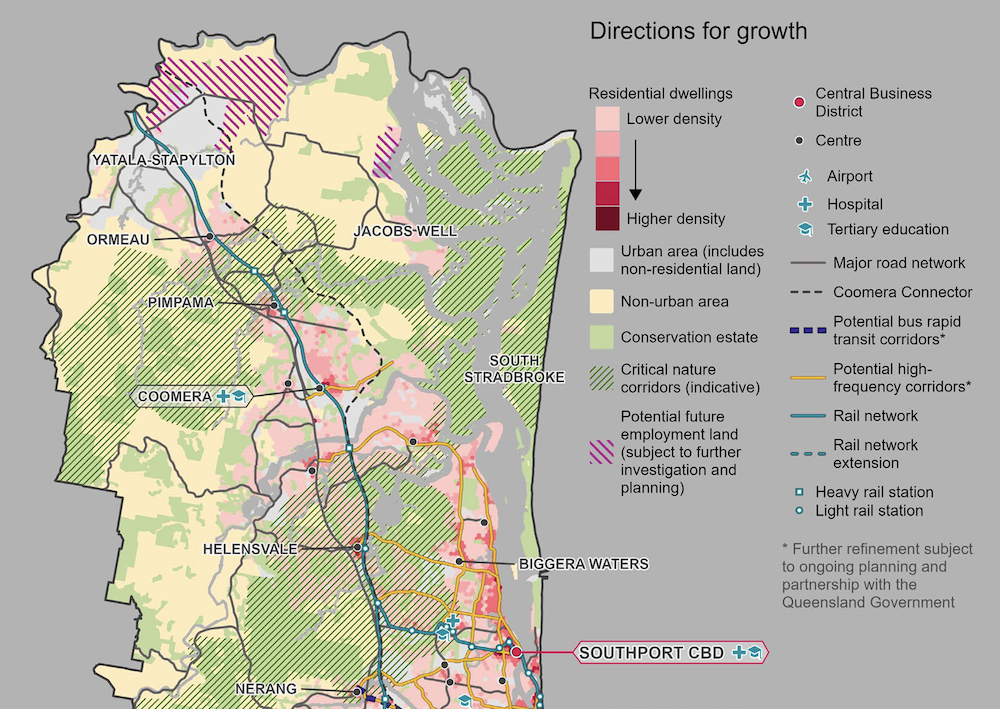
In the LGIP, we saw very uneven growth projections, with Labrador sitting near the top of the city for population and dwelling increases.
In the LGMS, we saw increased height and density flagged for Labrador and Parkwood, with references to growth around transport corridors.
Now, with Local Area Plans, we’re being told these are the tool to protect local character in areas of change, but when it comes time to apply that:
-
Labrador and Chirn Park (high growth and character) → not included
-
Parkwood (light rail, investigation area) → not included
-
Main Beach (not assessed, didn’t meet criteria) → added?
When final decisions don’t align with the process that was set out, it creates confusion and leaves the community trying to fill in the gaps.
When you step back and look at all of this — the LGIP, the LGMS, and now Local Area Plans — the same pattern keeps coming up.
Our area is flagged for growth, significant change is being planned, but when it comes to detailed, local planning… we’re missing.
At the same time, we’ve seen:
- another suburb added without meeting the criteria
- a clear invitation for councillors to advocate for their areas
- multiple opportunities to raise local concerns
And none of those opportunities were taken up for our community… no one is speaking up for our area.
Why is our councillor silent on community concern?
Between July and September 2025, all divisional councillors were consulted one-on-one about this framework.
There were multiple opportunities to:
- raise local concerns
- advocate for suburbs
- signal areas needing more detailed planning
Councillors were explicitly told by the planning chair in a meeting:
if there’s an area you want to publicly show you’re listening to, bring it forward.
That opportunity has been there for months.
It was used for Main Beach, but not for our area.
Why?
Our community have spent years trying to have our voices heard when it comes to city planning.
Then when our councillor could advocate, ask questions and even put our suburbs forward for proper planning… it hasn’t happened.
The councillor was also recently appointed Deputy Chair of the Planning Committee, replacing Cr Dan Doran, who regularly speaks up for his division on planning matters.
His new role comes with influence and responsibility, but we have had nothing but silence on the LGIP, LGMS and now these Local Area Plans.
Final thoughts
We know growth is coming.
What the community is asking for is the same opportunity other suburbs are being given — to shape that growth and protect local character.
Given the previous target growth and how the LGMS is headed, it’s only fair that our suburbs are part of the conversation at the same level as others.
Right now, it doesn’t feel like we are.
Newsletter signup
Stay up to date on local issues:
Other blog posts in this series
- LGIP, LGMS and the City Plan: What’s the difference and why it matters
- Understanding the Gold Coast’s Local Growth Management Strategy (LGMS)